
Can a wave look rough for a moment but behave better over time?
Imagine watching a crowd cross a station concourse. For a few seconds, several streams of people meet in one spot. A photograph makes the station look impossibly crowded. A video shows the gathering forming and dispersing.
Waves can concentrate briefly too. The mathematical question is more precise than “does the peak disappear?” It asks how much concentration is possible across both space and time, given the wave’s starting conditions. That difference between a snapshot and a movie is a useful entrance to local smoothing, the subject of a new mathematics claim announced by OpenAI on October 26.
You do not need calculus to follow the question. You do need one distinction: an explanation that makes a claim understandable is not a verification that its proof is correct.
First, a small experiment
Picture two pulses moving toward each other along a stretched rope. When their upward displacements coincide, they add. The overlap can briefly be taller than either pulse alone. Afterward, the pulses can continue on their way. This is the principle of superposition for a linear wave: add the displacements at each position and time. OpenStax’s introduction to interference explains this starting point.
Before moving the time control, make a prediction: would one photograph taken at the overlap tell you how concentrated the wave remains during the whole sequence? What additional information would you want?
Try the idea / 01
Two waves. One brief meeting.
Move through time. Watch what happens when the two pulses meet.
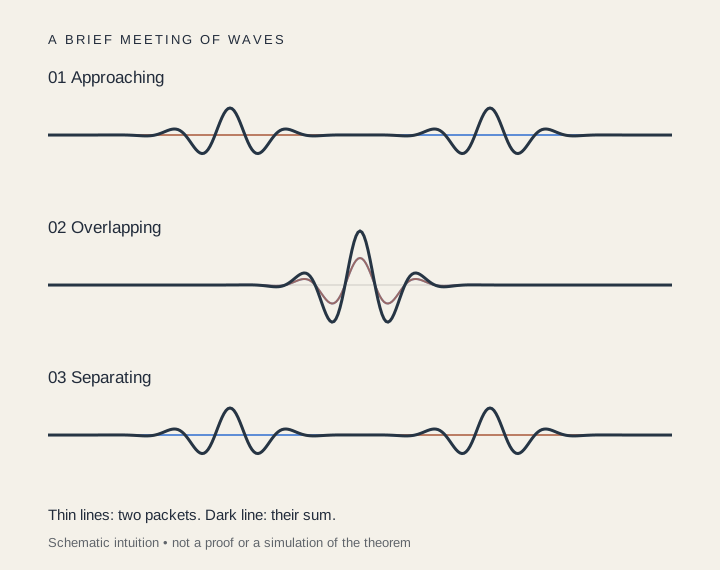
There is a limit to our rope example. In higher dimensions, waves can travel in many directions, and geometric arrangements of those directions matter. A simple overlap picture helps us notice the question; it cannot answer the full problem.
What does “smoothing” mean here?
The Euclidean wave equation is an ideal mathematical description of wave motion in ordinary flat space. Its solutions can include waves arriving from many directions and briefly focusing. Mathematicians compare a measure of the resulting wave over a bounded time interval with a measure of its initial data.
“Smoothness” describes, roughly, how much fine-scale variation that data has. The estimate asks how much initial smoothness is needed to control the evolving wave. Local smoothing seeks an improvement from considering space and time together instead of relying only on a fixed-time estimate. The technical statement keeps track of spatial dimension, the kind of magnitude measurement used, and a small permitted loss. Those qualifications are part of the claim. The released paper’s introduction and theorem give the precise version.
This is not the claim that every wave becomes visibly blurry, that energy vanishes, or that positive and negative waves cancel when averaged. The estimate measures magnitudes across space and time; brief peaks are still allowed.
A little more mathematics: what the experiment actually computes
At each position and time, the drawing adds two displacements:
Here, x is position along the rope and t is time. At perfect overlap the two equal pulses have twice the displacement. This equation describes our illustration, not the local smoothing estimate. The paper’s theorem instead compares space-and-time norms of a wave with a regularity norm of its initial data, under stated dimension and exponent conditions.
What has OpenAI reported?
OpenAI reports an AI-produced proof of the local smoothing conjecture for the Euclidean wave equation in all spatial dimensions. The accompanying formalization notes specify dimensions two and higher and spell out the estimates’ ranges and losses. They also list consequences for Kakeya and Fourier restriction problems. These are claims from the released materials, not conclusions independently established by this post. Announcement · formalization scope.
This builds on a substantial mathematical history. For example, Larry Guth, Hong Wang, and Ruixiang Zhang established the local smoothing conjecture in two spatial dimensions; their related cone estimate appeared in the Annals of Mathematics in 2020. A new all-dimensional claim should not erase that earlier work. Earlier paper.
Why would this matter beyond waves?
One connection leads to the Kakeya question: how small can a set be if it contains a unit line segment pointing in every direction? That sounds far from a moving wave. But arranging many thin directional pieces is also central to understanding how waves concentrate.
The released scope document includes a full Hausdorff dimension conclusion for such sets. “Full dimension” is a technical measure of geometric complexity; it does not mean the set must occupy a positive amount of ordinary volume. Keeping that distinction prevents an appealing but incorrect headline.
If the reported result withstands scrutiny, it would connect important questions about geometry and oscillation. It does not by itself deliver a new microscope feature, fix an image, or establish a claim about every real ocean wave. For a curious reader, the reward is seeing how one question can reveal structure shared by several fields.
What still needs to be understood?
OpenAI describes these manuscripts as raw research data and says the mathematics output is being released for researchers to study and explain. A Lean formalization provides another way to examine the argument. Lean’s kernel checks formal proofs against their exact statements, definitions, and assumptions. People still need to understand what those statements say and how they match the intended mathematical result. How Lean validates proofs.
For this explanation, we checked the announcement, paper introduction, formalization scope, and earlier literature. We have not independently checked the full proof or reproduced its Lean build. As of October 27, we have not identified a completed independent audit of this newly released all-dimensional result in the public sources checked. That is a limit of our review, not proof that no review exists. A later expert assessment could change how this post should describe the claim.
Let’s work on the understanding together
Which part helped more: the station crowd, the overlapping pulses, or the snapshot-versus-movie question? Where does the analogy stop helping?
In the community, share a question, your own sketch, or a source that improves this explanation. If you think something is wrong, quote the sentence and explain the correction. You can also start your own topic in Learn & Discover. The useful outcome is a clearer shared understanding—including an honest account of what we still do not know.
Understanding is a conversation
Think together.
What did the snapshot miss that the whole sequence revealed? Share a sketch, a question, or a correction.
Join the discussion ↗Public discussions on Discourse. Read freely; sign in there to reply.